
What If You’re Judging Your Story Too Soon?


There’s an old story about a farmer that I’ve always loved.
Things keep happening to him, and every time, the people around him are quick to decide whether it’s good luck or bad luck. His horse runs away. Bad luck. The horse comes back with more horses. Good luck. His son gets injured. Bad luck. Then a war breaks out, and because of the injury, his son isn’t drafted. Good luck.
And every time people tell the farmer how lucky or unlucky he is, his response is more or less the same:
Maybe. Who knows?
I’ve been thinking about that story a lot lately.
And, somewhat surprisingly, what brought me back to it this time was AI.
A few days ago, I was thinking about the revolution happening in the world of work, and particularly in marketing, where I spent so many years. I started wondering what my work would look like today, what would be happening to the business I had built, and how I would be dealing with the enormous changes happening in that industry.
And suddenly, something clicked.
To explain what, I need to go back six years.
Six years ago, I discovered that I carry the BRCA1 gene mutation.
I was 40, a mother of three girls, and suddenly I was facing some pretty confronting decisions.
I didn’t spend too much time asking, “Why me?” (although of course the thought crossed my mind). I was much more practical about it.
I wanted to see my girls grow up. I wanted to see them build their own lives. And I didn’t want to go through the same cycle of fear every year around my mammogram, wondering whether this would be the time they found something.
So I decided to do the most decisive thing I could do to feel a little more in control.
I had a preventative double mastectomy and had my ovaries removed, which put me straight into menopause at 40.
I was very practical about the decision.
That absolutely does not mean I wasn’t scared.
I was terrified of the surgeries. There were moments when I had that most basic fear that something could happen and that would simply be it… my life could end. I had no idea how I would cope with going into menopause so early, and plenty of other fears came and went on a fairly regular basis.
And, as if the timing wasn’t interesting enough, all of this happened just as COVID began.
Hospitals had restrictions, support looked very different, and even my husband could only visit me for a very limited amount of time.
At no point would I have called any of this “a good thing.”
But at the same time, something else was beginning to shift.
To help myself cope emotionally with everything I was going through, I started speaking regularly with a life coach.
There wasn’t one big dramatic moment of enlightenment. It happened slowly.
I started questioning things I had previously just accepted without thinking much about them.
How much space did I want work to take up in my life?
Was I being the mother I wanted to be?
What actually mattered to me?
And did the life I had built still fit me?
Eventually, those questions led to a major change in my business life (another long story..), and I found myself looking for a new version of myself.
I was trying to figure out what people like to call their “zone of genius” - that thing you’re really good at, but that somehow also feels a little more right.
At some point, I was encouraged to study something that had absolutely nothing to do with my work. And for reasons I couldn’t really explain, I was drawn to sound healing.
And when I say I knew almost nothing about it, I really mean almost nothing.
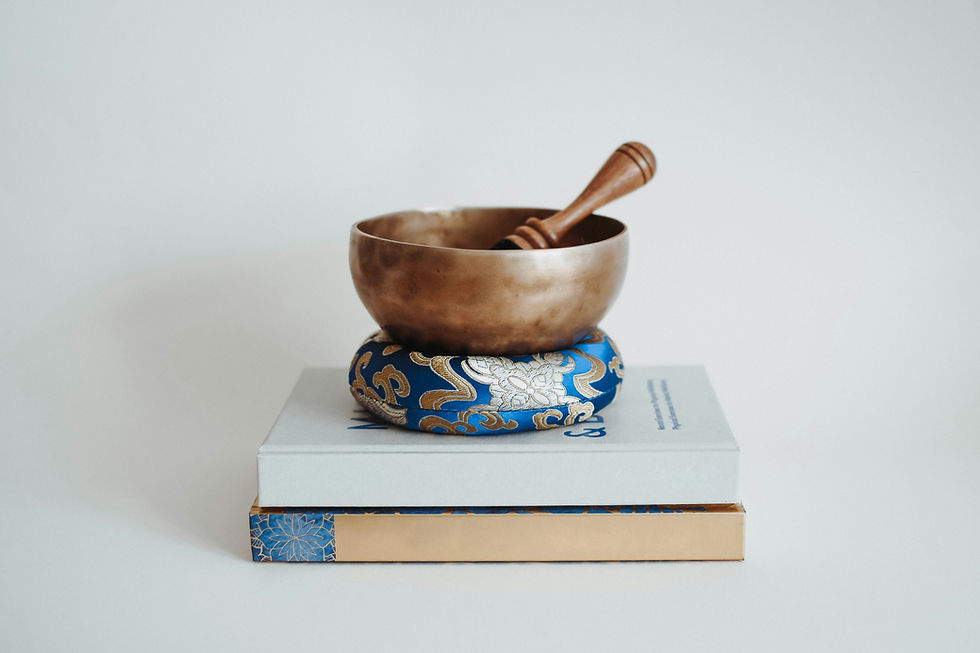
I saw a singing bowl, remembered seeing someone use one on herself once, and I was intrigued.
That was pretty much it.
So I followed the curiosity.
I studied. Then I studied some more. Eventually, I became fully certified.
But throughout all of this, I was still running my marketing business and working with startups, and I was very clear about one thing:
I was not becoming a sound healer.
This was for me.
Maybe for my family.
But it definitely wasn’t going to become a new career. I wasn’t opening a clinic. I wasn’t going to start working with clients.
Apparently, life had its own sense of humour about all that certainty.
A few years later, I found myself struggling emotionally in a way I hadn’t before.
I was hurting. I felt overwhelmed.
I went to a friend who gave me a sound session, and within a few hours, I felt a noticeable shift.
The reality hadn’t changed.
The things that hurt still hurt.
Nothing had magically disappeared.
But I could breathe again.
I could feel a little more optimistic. I could direct my energy towards something else instead of feeling completely swallowed by it.
And I thought:
I want other people in my community to be able to feel this too.
So I decided to pay it forward.
I organised a session for my local community.
That session became another one.
Then regular events that opened to the wider public.
Then private clients.
Then a clinic.
And somewhere along the way, slowly but surely, marketing took up less and less space in my life until eventually I stopped doing it altogether.
Sound Journey became my work.
If you had told 40-year-old me, sitting there terrified about surgery and menopause, that this was what my life would look like six years later, I probably would have laughed my head off.
Which brings me back to AI.
A few days ago, I found myself thinking again about the marketing world I had left behind and what is happening to it now.
The type of work I used to do for startups is changing at an incredible pace. Today, businesses can do, for a fraction of the cost, things they once needed people like me to do for them.
I still strongly believe that you need someone who actually understands what you’re trying to achieve to drive those tools properly.
But would I be able to convince cash-conscious startups to keep paying the same kind of fees for that expertise?
Maybe.
Maybe not.
And suddenly, it hit me.
If I were still running that same business today, I might be pretty stressed right now.
I might be wondering whether my business model was going to survive.
I might be asking myself what else I could do.
I might be standing here in my mid-40s, facing the very daunting prospect of having to reinvent myself.
Except…
I already did.
I’ve already spent the last six years reinventing myself.
Not because I saw AI coming.
Not because I had some brilliant six-year strategic plan.
And not because I cleverly predicted the future of marketing and pivoted at exactly the right time.
I did it because I discovered I carried a gene I would have been very happy never to discover.
And that discovery led to surgery.
The surgery led me to seek support.
That support led me to start questioning my life.
Those questions led me to try something completely outside my world.
That curiosity led me to sound.
And sound eventually became the path I’m on today.
Would I say that discovering BRCA1 was a good thing?
No.
Would I say the fear, the surgeries, early menopause or the difficult things that followed were “for the best”?
I don’t think I need to.
Maybe that’s exactly the point.
We are so quick to stand in the middle of one chapter and decide what the entire story means.
This is terrible.
This is wonderful.
I’m so lucky.
I’m so unlucky.
But from inside that moment, we can see such a tiny part of the picture.
I do believe there is something that sometimes nudges us in certain directions. Call it the universe, intuition, God, life — whatever works for you.
But we also have to be open enough to notice when the direction changes.
I could have ignored my curiosity about that singing bowl.
I could have finished my studies and left the instruments sitting at home.
I could have kept insisting, “This isn’t what I do.”
There were choices all along the way.
So maybe life places things in our path, but we still have to choose whether to walk towards them.
And perhaps that’s what I take from the farmer’s story now.
It’s not necessarily “everything happens for the best.”
And it’s not necessarily “everything happens for a reason.”
It’s simply:
We don’t know yet.
The thing you would give anything today not to have happened may end up changing the direction of your life.
And the opposite is true too - something that looks like incredible luck today may turn out very differently.
Sometimes it takes years before we can see enough of the picture to understand how the pieces connect.
And sometimes, perhaps, we never get to see the whole picture at all.
So, was discovering BRCA1 a good thing or a bad thing?
Ask me again in another six years.


Comments